Seeing the Circle
Why Faith Still Sees What the Culture Cannot
“It is a characteristic of any decaying civilization that the great masses of the people are unconscious of the tragedy. Humanity in a crisis is generally insensitive to the gravity of the times in which it lives. Men do not want to believe their own times are wicked, partly because it involves too much self-accusation and principally because they have no standards outside of themselves by which to measure their times. If there is no fixed concept of justice how shall men know it is violated? Only those who live by faith really know what is happening in the world; the great masses without faith are unconscious of the destructive processes going on, because they have lost the vision of the heights from which they have fallen. The tragedy is not that the hairs of our civilization are gray; it is rather that we fail to see that they are.” — Fulton J. Sheen, Communism and the Conscience of the West (1948)
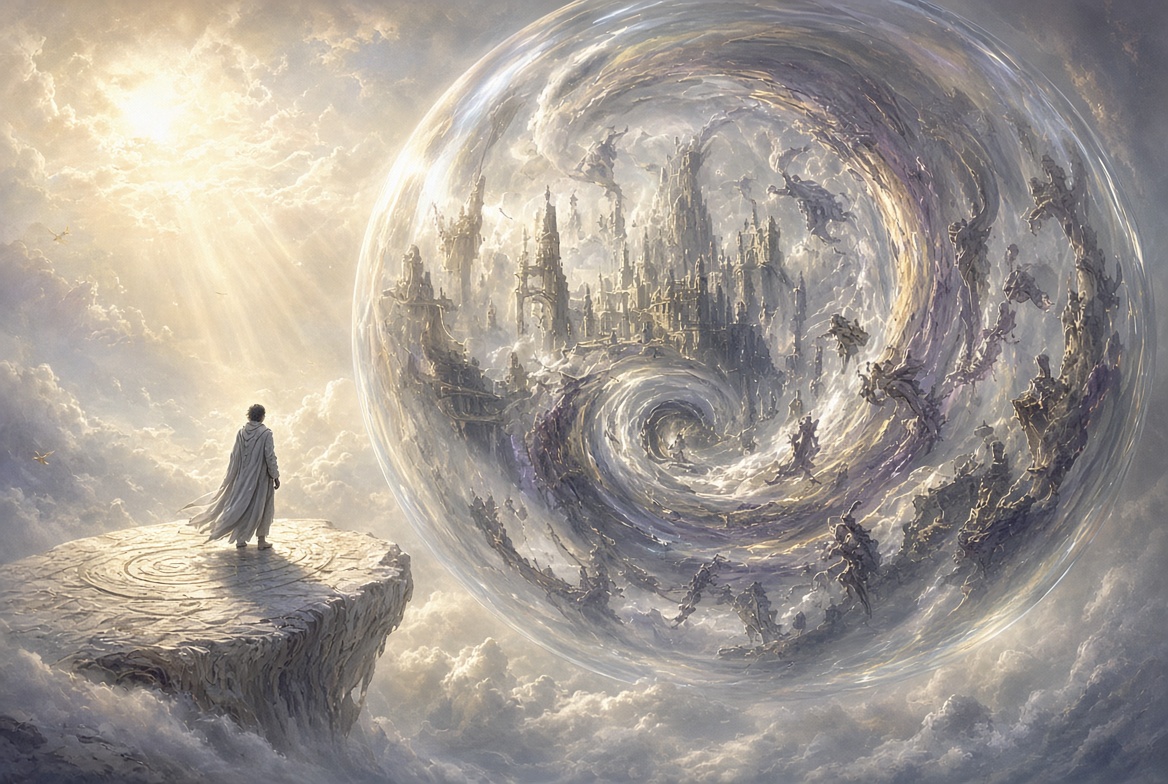
There is an image that has returned in our day: a closed circle in which people only hear what already confirms what they believe. Some call it a bubble. An older image is the Ouroboros — the snake that swallows its own tail. Both pictures describe the same condition Sheen named. When a culture loses any standard outside itself, it begins to feed on its own assumptions. Language, entertainment, education, and public morality all circle within the same enclosure. Inside that circle the decline is invisible. The people do not feel the tragedy because they have no vantage point from which to measure it.
The same pattern is visible in two places that touch nearly every household. Beginning in the early 2010s, rates of depression, anxiety, and loneliness among adolescents and young adults rose sharply across the English-speaking world. Clinical depression among teens more than doubled in roughly a decade; school loneliness nearly doubled worldwide. The ordinary shape of well-being across a lifetime inverted so that the young now report higher despair than older cohorts. The timing coincides with the arrival of smartphones and algorithmic feeds that reward engagement through comparison and isolation. Inside the circle this is often treated as normal life or even progress. From outside it is clearer: more time spent inside the feed correlates with less real friendship and a generation less practiced in the ordinary difficulties of life.
A second circle appears in the fertility and relationship recession. Total fertility in the United States has fallen below 1.6, well under replacement. Millions more women in their primary childbearing years are childless than earlier demographic patterns predicted, and the cumulative birth deficit since the mid-2000s numbers in the millions. Parallel data show a thinning of friendships and a rise in singledom. Most people still say they want more children than they are having; the shortfall is downstream of isolation and the absence of the ordinary social support that once made family life normal. Inside many cultural circles this is narrated as pure individual choice or liberation. The external standard—the long human pattern of family as the basic unit of continuity—is no longer shared. From that height the quiet consumption of a civilization’s future becomes visible.
Faith is that vantage point.
It is not merely a private feeling; it is the recovery of the heights from which we have fallen. From those heights the circle can be seen. The self-consuming motion becomes clear. The gray hairs are no longer hidden. This is why those who live by faith are not more anxious than their neighbors; they are simply less surprised. They have a fixed concept of justice, of the human person, of the purpose of life. They can recognize when those realities are being violated.
Scripture has long named this difference between those who can see and those who cannot. The prophet Isaiah warned, “Woe to those who call evil good and good evil, who put darkness for light and light for darkness” (Isaiah 5:20). When a people lose any measure outside themselves, the names of things reverse and the reversal itself becomes invisible. Jesus later asked those who could read the weather but not their own moment, “You know how to interpret the appearance of the sky, but you cannot interpret the signs of the times” (Matthew 16:3). The capacity to discern does not come from remaining inside the circle; it comes from standing under a standard the circle does not supply. The apostle Paul therefore wrote, “Do not be conformed to this world, but be transformed by the renewal of your mind” (Romans 12:2). Renewal is the practical refusal to let the circle become the only voice that defines reality.
The danger for any of us is to remain inside the circle while believing we have already stepped outside it. The bubble is comfortable. It flatters. It reassures us that the problem is always elsewhere. Observation alone is not enough; neither is alarm.
What is required is the deliberate act of standing on the heights — of returning, again and again, to the Word of God and to prayer — so that the circle loses its power to define reality for us.
Visitors to this place are invited to that posture: observe carefully what is happening in the culture around you; measure it by something other than the culture’s own voice; and pray. Prayer is the practical refusal to be swallowed by the tail. It keeps the heart oriented toward the heights even when the circle grows tighter. In that orientation there is clarity, and with clarity there is the possibility of remaining human in a time that is forgetting what human means.
Yet the call does not end with clearer sight. Not all is lost. The same God who gives the vantage point of faith also supplies the remedy for the fall. He does not leave us merely to observe the circle; He invites us to step out of it by receiving the Word and the work accomplished on the cross. “For God so loved the world, that he gave his only Son, that whoever believes in him should not perish but have eternal life” (John 3:16). The cross is the place where the self-consuming pattern of sin is broken. Christ entered the closed circle of human rebellion, bore its full weight, and opened a way out. “God shows his love for us in that while we were still sinners, Christ died for us” (Romans 5:8). That is the fixed standard the culture cannot generate for itself: a righteousness that comes from outside, offered freely to any who will receive it.
Because this is true, those who stand on the heights are not called only to watch. They are called to pray and to speak. The risen Lord commissioned His people to carry this same word into every generation: “Go therefore and make disciples of all nations… teaching them to observe all that I have commanded you” (Matthew 28:19–20). In a fallen world the gospel remains the one message that can interrupt the Ouroboros. It does not depend on the culture’s mood or the strength of the circle. It depends on the finished work of Christ and the Spirit who still opens eyes.
So the invitation is simple and personal. If you have never come to Christ, the way is open now. “If you confess with your mouth that Jesus is Lord and believe in your heart that God raised him from the dead, you will be saved” (Romans 10:9). Come to the cross. Receive the Word. Step onto the heights. And if you have already believed, renew that same faith today. Return to the cross. Remember that the circle does not have the last word. Pray. Share the gospel with those still inside. Live as one who has seen the heights and knows that rescue is real.
All is not lost. The gray hairs are real, but so is the Savior who still calls. Come to Christ, or come back to Him. The heights remain, and the door is open.
The Music “Outside the Circle” – The Lyrics

Artist: Treasured Heart – Rock Gospel
[Verse 1]
Gray hairs on the tower, nobody sees
The circle keeps spinning, eating its own
Feeds on the same words, same empty degrees
Lost in the bubble, never alone
I stood on the edge where the light still breaks
Watching the storm that the people ignore
[Pre-Chorus]
They call it the sky, I know it’s the fall
They measure the weather, miss the sign
[Chorus]
Outside the circle, the heights remain
Don’t let the tail swallow what burns
Come to the cross in the driving rain
Outside the circle, stay awake
The gray is real but the door is open
[Verse 2]
Kids in the feed with the lights turned low
Friends getting thinner, the numbers decline
They name it freedom, the future won’t grow
Inside the loop where the mirrors all shine
I heard the old warning still cutting through
Woe to the ones who reverse the light
[Pre-Chorus]
You read the clouds, can you read the times
The standard is fixed and it isn’t yours
[Chorus]
Outside the circle, the heights remain
Don’t let the tail swallow what burns
Come to the cross in the driving rain
Outside the circle, stay awake
The gray is real but the door is open
[Bridge]
Not all is lost
The Word still speaks
While we were still sinners
The work was complete
Stand on the heights
Pray and speak
The circle breaks
When the heart is free
[Final Chorus]
Outside the circle, the heights remain
Don’t let the tail swallow what burns
Come to the cross in the driving rain
Outside the circle, come or return
All is not lost
The Savior still calls