The House I Learned
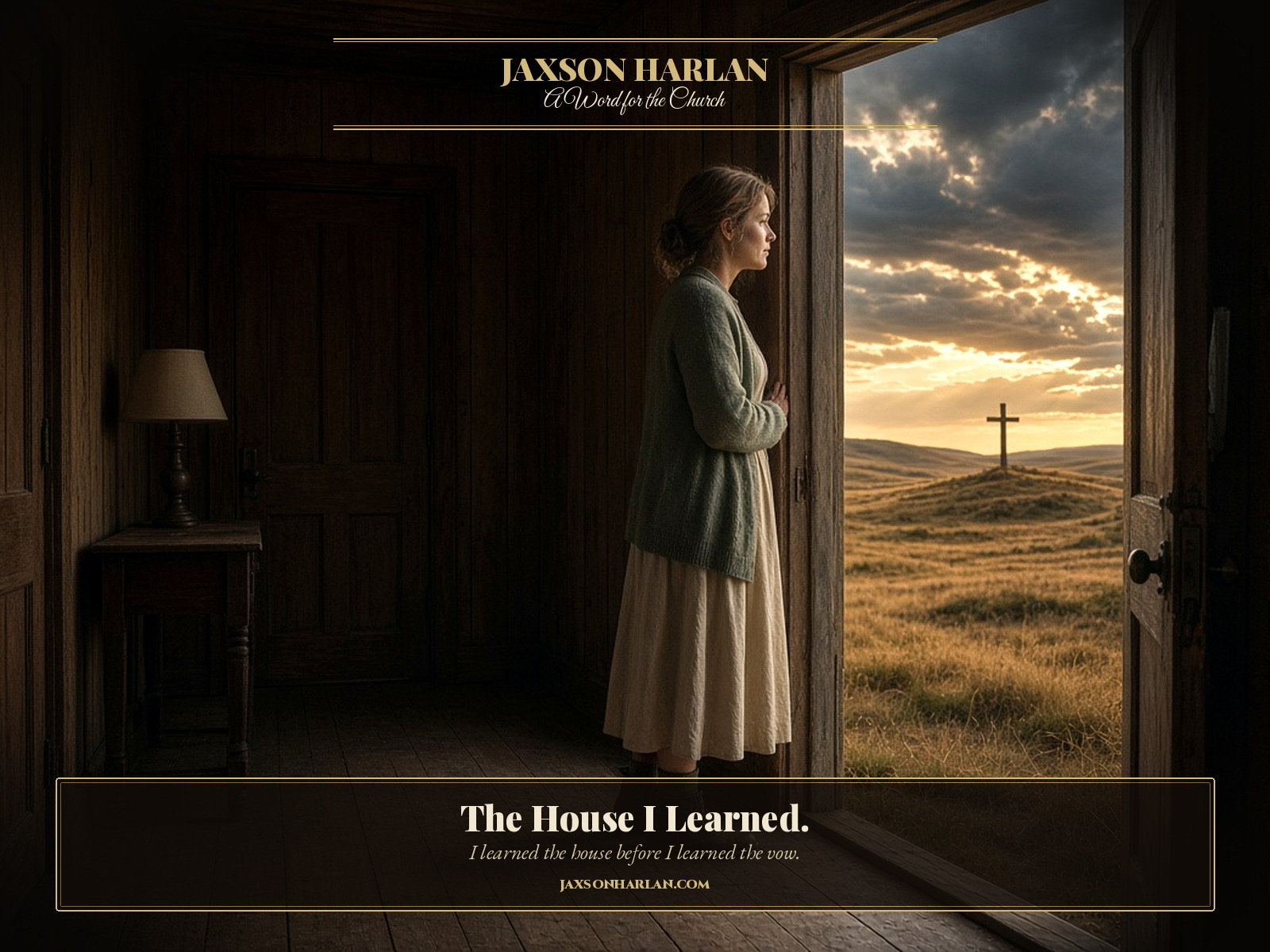
How you get to the altar can change. What a thin yes costs does not.
A word for anyone who grew up in a quiet, unhappy house and is being asked to marry before they have healed — and for a church that knows how to decorate a wedding better than it knows how to ask whether the yes is real.
There is a hallway most people never put in the wedding programme.
Father sits in the living room with the lamp off. The only light is the end of his cigarette. Mother is behind a closed door with a magazine and one last polite sentence. A child learns which floorboards will give her away. Someone still says sweet dreams. Nobody in the house remembers how to dream.
Years later a man says it is time. Time to move in. Time to raise a family. Time to do what she has always heard people do. He talks as if the two of them will rise above every sad marriage she has ever seen. She looks back at the hallway she came from. She looks at the neat lawns her friends already keep. And she can feel a yes forming in her mouth before her heart has caught up.
A song from 1971 caught that girl in the middle of that moment. I am not going to put the singer’s name on this page. The name will make some of you argue about music and decades, and this is not a lesson in records. It is a kitchen-table word for anyone who learned love by watching it hide, and is now being handed a plan and told the plan is a covenant.
The song already told the truth about the culture. Courtship, a clear proposal, then a vow — that was no longer the only respectable path. Moving in had become a middle step. Marriage was starting to look like paperwork you sign after you have tested the relationship and the lease looks stable. That shift is real. It has only gone further.
But if we stop there, we will tell a prettier lie. The house in the first part of that song was not a modern experiment. It had a master bedroom, a child in the hall, and the language of a family. It was a traditional marriage with the lights off. The friends with the lawns were not “trying it out.” They had the rings, the children, the quiet afternoons, the angry mornings, and a laugh they used so no one would see the wound. Tradition did not save that house. Sharing an apartment will not save yours either.
The path to the wedding kept changing. The house itself never got repaired.
What she can see
Give her that much. She is not making the weather up.
She has watched a marriage keep the furniture and lose the conversation. She has watched people drink and laugh and cover a wound and call the evening fine. She has heard big promises from a man who has not yet shown her what he does with his own hurt. She is afraid she will be treated like something owned before she has ever become a person. She is afraid that if she says yes, she will drag that hallway into the next address and teach another child how it sounds.
Seeing danger is not a character flaw. A woman who pulls back because something in his voice sounds like control is not being difficult. She is paying attention. Some men do treat a wife like a thing on a shelf. Some women do the same with a husband. A controlling home is not a covenant just because a church will print the names.
The trouble is not that she sees wreckage. The trouble is that wreckage has become the only story she trusts.
All I know is what I see. If the only marriages she has stood close to were quiet and dead, she will start to think that is what marriage is. Then two thin roads open, and both of them feel wise.
One road is the tired yes. You want to marry me — we’ll marry. She does the expected thing while she still believes the expected thing will slowly drown her.
The other road is a no that never becomes healing. She will not sign. She also will not leave the patterns she learned. She carries the old hallway into every new kitchen and calls the distance wisdom.
A church is often gentler with the first road than it should be. We know how to book a date. We are less practised at asking whether anyone has actually left the house that formed them.
The last yes is not always faith
The last chorus of that old song is the part a wedding band used to miss. If you only catch the title line, it sounds like a woman coming around. It is not conversion. It is giving in.
She does not meet the Lord in that yes. She meets the plan. Family pressure. Age. The fear of being the last single person at the table. A kitchen they already share. A house that is next. Well, okay.
That is how a lot of church weddings happen too. Not all of them. If your vow was costly and you meant it, this is not a verdict on your day. Hear the other kind: the Saturday that looked holy because the flowers arrived, and five years later the old wound starts talking and everyone acts surprised.
Longing for a home is not a sin. Wanting children is not a sin. Being tired of walking alone is not a sin. Those things become dangerous when they are the only reason you say yes. Weariness can put on a dress. Weariness can put on a borrowed suit. Weariness can say I do loud enough for the microphone.
Faith can say I do as well. The two yeses do not feel the same in the kitchen the night before. One person has already left the old house. The other is still walking softly so the floor will not give them away.
Leave the house you learned
Scripture does not begin a marriage with decorations. It begins with a verb most families skip because it sounds unkind.
“Therefore a man shall leave his father and his mother and hold fast to his wife, and they shall become one flesh.” Genesis 2:24
Leave. Then hold on. The order is mercy. You cannot cling well to a husband or a wife while you are still living inside the atmosphere that trained you. Honour is not copying them. You may love the people who raised you and still refuse to live the night they lived.
The old hallway is not a prophecy. Patterns are real. Destiny is not.
“The soul who sins shall die. The son shall not suffer for the iniquity of the father, nor the father suffer for the iniquity of the son.” Ezekiel 18:20
You are allowed to tell the truth about what you saw. You are not required to repeat it. Some of what gets called fear of marriage is unfinished leaving. The old dark is still writing sentences in your mouth. A ring will not silence that. A ring will only give it a new address.
The plan is not the covenant
What she had always heard was a plan. Plans feel like wisdom because everybody is repeating them.
In one generation the plan was: court, announce, marry, keep the lawn, and do not tell the church what the nights are like. In the next it was: move in, see if you like the arrangement, raise a family if it works, and use the word marry if you still need it. Different stairs. The same thin yes hiding under both.
“Do not be conformed to this world, but be transformed by the renewal of your mind, that by testing you may discern what is the will of God, what is good and acceptable and perfect.” Romans 12:2
Fitting in can look old-fashioned. It can look modern. The test is not whether your grandmother would recognise the path. The test is whether a mind has been made new enough to tell a real vow from a timetable.
Marriage is still honourable. We do not protect it by pretending the lawns are fine. We also do not protect it by treating every vow as wreckage.
“Let marriage be held in honour among all, and let the marriage bed be undefiled, for God will judge the sexually immoral and adulterous.” Hebrews 13:4
Honour is heavier than a shared lease. It is heavier than a pretty Saturday. It is two people, before God, leaving and holding on, with a bed that belongs to the covenant and not to a trial run. Moving in “to see if it is safe” is not caution. It is trying to eat the fruit to find out whether the tree is good. You will learn something that way. You will also have already taken what the vow was meant to protect. You do not practise a covenant by borrowing its privileges.
That sentence will offend some kind people. Say it without sneering. A lot of them were never offered another plan. They heard move in the way their parents heard marry — as the next expected thing — and they were trying not to be alone. The Lord is not mocked. He is also not cruel to people who were only following the hallway they knew. Come off that path. Do not spend the rest of the page despising the people still on it.
Control is not a vow
When the man talks about soaring, she hears a cage. She is not being dramatic. She has watched love turn into ownership before, and her body flinches before her mouth can explain it. Do not scold her for that.
From the beginning, marriage was not a trap. Hard hearts made the wreckage she can see. Jesus said so without pretending the wreckage was imaginary.
“He said to them, “Because of your hardness of heart Moses allowed you to divorce your wives, but from the beginning it was not so.”” Matthew 19:8
From the beginning a man leaves, a woman is met, and the two become one flesh under God. That is not ownership. When the church is telling the truth, a husband’s pattern is not control.
“Husbands, love your wives, as Christ loved the church and gave himself up for her, that he might sanctify her.” Ephesians 5:25–26
Christ does not put the church on a shelf. He gives Himself up. If a man only soars in his speech and owns in his practice, that is not Ephesians. That is the boyfriend in the song. You are not required to marry control and call it faith. Seeing the danger is not unbelief.
And the other side, so this message does not teach you that holiness means never belonging to anyone:
“Then the Lord God said, “It is not good that the man should be alone; I will make him a helper fit for him.”” Genesis 2:18
Being alone is not the saved condition. Being owned is not the saved condition either. The Gospel does not pick one of those errors and bless it.
Become a person first
She was right about the order, even when she did not have the Name. A person who has never become a self before God will use a marriage to finish a job a vow cannot do. She will ask a husband to teach her how to dream. He cannot. He can love her. He cannot be her beginning.
“For your Maker is your husband, the Lord of hosts is his name; and the Holy One of Israel is your Redeemer, the God of the whole earth he is called.” Isaiah 54:5
That is how “become a person first” stays Christian, and does not turn into the old lie that you are most yourself when you belong to no one. Before she is anyone’s bride she is already seen. Before he is anyone’s husband he is already bought. The first yes is not to a man and not to a cage. It is to the Lord who can put a new heart where the old hallway used to write the lines.
“Therefore, if anyone is in Christ, he is a new creation. The old has passed away; behold, the new has come.” 2 Corinthians 5:17
A new creation is how a woman learns to dream again. Not the lawn. Not a tired okay. Not a better speech from the boyfriend. A mind made new enough to leave — and then, if the man is good, and if the Lord is in the room, to hold on without dragging the dark down the aisle.
Guard your heart. Not because feeling is the enemy. Because the springs of your life run from there, and a hallway that was never named will keep feeding the well.
“Keep your heart with all vigilance, for from it flow the springs of life.” Proverbs 4:23
How she could have seen it
If that girl had been told the truth, she would not have needed a colder man or a warmer nostalgia. She would have needed a different reading of her own kitchen.
- She could have seen the dark living room as a wound, not as the definition of marriage.
- She could have seen her friends’ lawns as hard hearts, not as proof that holding on always means drowning.
- She could have heard the boyfriend’s hurry as a plan, and asked whether he had laid his own dark down before he asked her to sign.
- She could have recognized control coming and named it, without deciding that every vow is control.
- She could have heard leave as permission to become a person before God, not as a slogan for never belonging.
- She could have said no to a thin Saturday without saying no to the Lord who still honours the covenant.
- She could have said yes later — a different kind of I do — if the leaving had happened and the man was good.
That is not advice-column Christianity. That is Genesis reaching a girl who thought the only two options were the old hallway and the tired yes.
If you are the church in the room
Stop blessing a collapse just because the date is booked.
Ask the question the reception cannot ask. Has anyone left the house that formed them? Does anyone still believe the expected thing will drown them, and are they doing it anyway? Do his big promises hide a need to control her? Is the apartment already doing the work of a vow, so the ceremony is only paperwork? You will feel unkind for a minute. You will be less cruel than a Saturday that sends two unhealed people home to hide a wound.
Do not make the opposite error and treat every engagement as suspect. Honourable marriage still exists. Quiet faithfulness still exists. Some people learned a dark house and, by the mercy of God, did not copy it. Celebrate them. Do not use them as a weapon.
And if you have used other people’s haste to keep from looking at your own hallway — the father with the lamp off, the mother with the magazine, the laugh you still use at lunch — put that down. This word is not only for a girl in 1971. It is for anyone who built a life on what they heard, and never asked whether God actually wrote it down.
The invitation
- You do not have to marry the darkness you learned.
- You do not have to call a social plan a vow.
- You do not have to walk into a controlling home and name it holiness.
- You do not have to stay in the old hallway and name it freedom.
Come to Christ first. Let Him be the first place you belong. Let the old life pass away in fact, not only in a caption. Then, if he asks, and if he is good, and if the Lord is in the room — leave the house you learned, and take a hand.
That is a different kind of I do.
The path to the altar changed. The cost of a thin yes did not. The girl in that song does not need a better plan. She needs to leave the house she learned, belong to the Lord who sees her, and refuse both control and the tired yes.
That is the way she always heard it should be. That is not the way He wrote it down.
The Music “The House I Learned” – The Lyrics

Artist(s) – Jaxson R. Harlan with Savannah Grayce
Verse 1
Daddy sat the dark with no lamp on
A cigarette for a star
Mama called sweet dreams down the hall
From a bed that felt that far
I learned the floors by how they creaked
I learned love by how it hid
I forgot the way a house can hope
Before I ever did
Chorus
That’s the way I always heard it should be
Move in, raise a name, play house, play free
You want to marry me — we’ll marry
Like the script was written just for me
But I learned the house before I learned the vow
And the dark I drank is drinking in me now
That’s the way I always heard it should be
That ain’t the way He wrote it down
Verse 2
The college friends all got their lawns
The quiet noons, the angry dawns
Kids who hate them for the lack
And laugh to keep the scar from talking back
You say we’ll keep this love alive
Babe, all I know is what I’ve seen
Couples cling and claw and drown
In the wreck of what they mean
Chorus
That’s the way I always heard it should be
Move in, raise a name, play house, play free
You want to marry me — we’ll marry
Like the script was written just for me
But I learned the house before I learned the vow
And the dark I drank is drinking in me now
That’s the way I always heard it should be
That ain’t the way He wrote it down
Verse 3
You say we’ll soar like two birds through the cloud
I hear a latch. I see a shelf.
I’m scared I’ll never learn to be
A soul first, by myself
Verse 3
Not because a vow is prison
Not because a ring is theft
Because I never watched a man
Lay his own dark down and leave
Bridge
Leave your father. Leave your mother.
That was mercy, not a slight.
You can honour what they suffered
And still refuse to live their night.
A covenant is not a cage
If the first Yes isn’t mine —
If He holds the house before a man does
The dark don’t get to write the line.
Chorus
That’s the way I always heard it should be
Move in, raise a name, play house, play free
You want to marry me — we’ll marry
Like the script was written just for me
But I learned the house before I learned the vow
And the dark I drank is drinking in me now
That’s the way I always heard it should be
That ain’t the way He wrote it down
Tag
Don’t marry the dark you learned
Don’t call the script a vow
Become a soul before a wife
Or you’ll drag that hallway down
Then if he asks, and if he’s clean
And if the Lord is in the room —
Leave the house you learned.
Then take a hand.
That’s a different kind of “I do.”
That’s the way I always heard it should be.
That ain’t the way He wrote it down.